
Regenerative Agriculture Explained — What It Means for Your Food
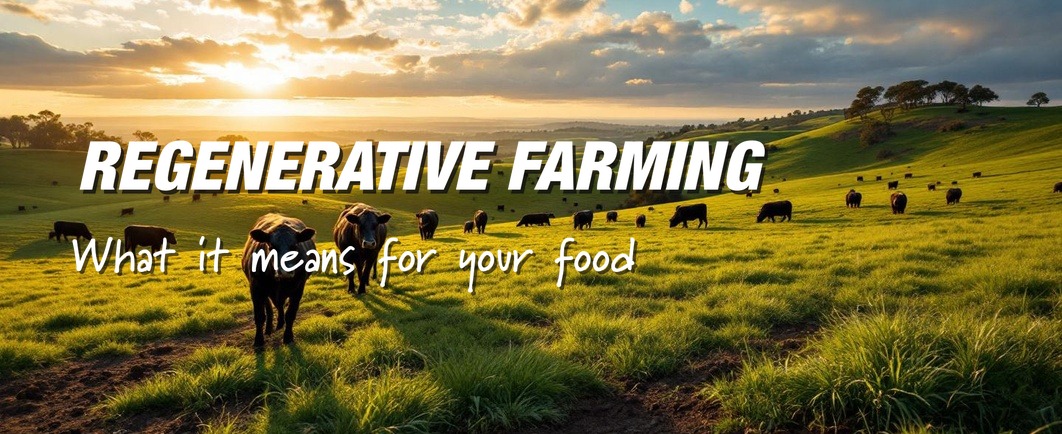
Regenerative Agriculture Explained — What It Means for Your Food
You've probably seen the word regenerative appearing on meat packaging, farming websites, and food brands over the past few years. Unlike terms such as "natural" or "artisan", regenerative agriculture refers to a set of farming principles with a growing body of scientific research behind them.
But what does regenerative agriculture actually mean, and does it make a difference to the food you eat?
Here's a practical look at what regenerative agriculture is, what the evidence says, and why it matters if you care about where your meat comes from.
What Is Regenerative Agriculture?
Regenerative agriculture is an approach to land management that focuses on improving soil health, increasing biodiversity, and supporting long-term ecosystem function.
While many conventional farming systems are designed around yield, efficiency, and input management, regenerative systems place greater emphasis on improving the condition of the land over time, rather than simply maintaining it.
There is no single universal definition of regenerative agriculture, but most frameworks share a number of common principles:
-
Minimising soil disturbance to protect soil structure and microbial life
-
Maintaining living roots and ground cover wherever possible
-
Increasing plant diversity through multi-species pastures and crop systems
-
Integrating livestock into grazing systems to recycle nutrients naturally
-
Reducing reliance on synthetic fertilisers, pesticides, and herbicides where practical
The concept draws on conservation agriculture, holistic grazing management, and aspects of organic farming. What distinguishes regenerative agriculture from many other farming approaches is its focus on measurable outcomes such as soil health, biodiversity, water retention, and ecosystem resilience.
What Does the Science Actually Say?
Research into regenerative agriculture has expanded significantly in recent years, and the overall findings are encouraging — although the picture is more nuanced than some marketing claims suggest.
On soil health, the evidence is positive. Studies have found that regenerative farming practices improves soil organic matter, increases biological activity, improves water infiltration and retention, and supports greater biodiversity compared with more intensive systems.
Australian and international case studies have also reported improvements in soil carbon levels and reductions in emissions intensity in some regenerative grazing systems.
How Farming Practices Can Influence Meat Quality
The connection between farming and food begins with the land. Healthy soils can support diverse and resilient pasture systems, which influence the diet available to grazing animals. In turn, research suggests that differences in feeding systems can affect the nutritional composition of meat.
For example, studies comparing grass-finished beef with grain-finished beef have found differences in fatty acid composition. Grass-finished beef often contains higher levels of omega-3 fatty acids and conjugated linoleic acid (CLA), along with a more favourable omega-6 to omega-3 ratio.
Research has also identified differences in certain antioxidants and plant-derived compounds present in meat from pasture-based systems. While differences in nutritional composition are measurable, researchers continue to study the extent to which these differences translate into meaningful health outcomes for consumers.
The quality of the pasture, the diversity of plant species, animal management, and finishing systems all contribute to the final product.
Certifications and Labels in Australia
One challenge for consumers is that "regenerative" is not currently a legally protected term in Australia. This means a product can be marketed as regenerative without necessarily being independently certified.
For consumers seeking greater transparency, several third-party certification systems now exist:
Certified Regenerative (Organic Food Chain)
Requires documented regenerative management plans, soil and plant monitoring, and annual independent audits.
Certified Regenerative Standard (SX Certified)
Focuses on livestock and agricultural production systems transitioning toward regenerative and chemical-free practices.
Regenerative Organic Certified (ROC)
Builds upon organic certification by adding requirements relating to soil health, animal welfare, and social responsibility.
These certifications provide independent verification and auditing, helping consumers distinguish between verified regenerative practices and marketing claims.
It is also worth noting that certifications such as Certified Humane provide third-party verification of animal welfare standards, which often align closely with regenerative and pasture-based farming systems.
How ButcherCrowd Sources Its Beef and Lamb
At ButcherCrowd, we believe transparency matters. Our beef is sourced through Greenham Australia's NEVER EVER Beef Program, one of Australia's most recognised grass-fed and finished beef standards.
The program requires cattle to be:
-
100% grass-fed and grass-finished
-
Lifetime antibiotic-free
-
Free from added hormones
-
GMO-free
-
Free-range
-
Fully traceable
-
Certified Humane
Greenham has also developed the Greenham Beef Sustainability Standard (GBSS), a voluntary sustainability framework designed to support and measure environmental outcomes across participating farms.
The program focuses on areas such as:
-
Soil health
-
Biodiversity
-
Carbon management
-
Animal welfare
-
Waterway protection
-
Long-term farm sustainability
More broadly, ButcherCrowd works with Australian farmers and producers who support regenerative and sustainable farming practices, including responsible grazing management, biodiversity protection, maintaining ground cover, and improving long-term land health.
Because regenerative agriculture isn’t governed by a single universal standard, we believe the most important thing is transparency around the actual practices being used — not simply the label applied to a product.
Why It Matters
Regenerative agriculture is ultimately about stewardship. The goal is not simply to produce food today, but to improve the land's ability to produce food tomorrow.
While regenerative farming is still evolving, there is growing evidence that well-managed regenerative systems can improve soil health, biodiversity, water retention, and ecosystem resilience.
For consumers, choosing food sourced from farmers who prioritise these outcomes can be one way to support farming systems focused on long-term sustainability rather than short-term extraction.
The Bottom Line
Regenerative agriculture isn’t a magic solution, nor is it simply a marketing trend.
It’s a farming philosophy centred around improving soil, biodiversity, and ecosystem health over time.
The evidence suggests that regenerative practices can deliver meaningful environmental benefits when implemented well, although outcomes vary depending on location, climate, and management.
For meat buyers, the most important questions remain:
-
How were the animals raised?
-
What were they fed?
-
How was the land managed?
-
Can the claims being made be verified?
At ButcherCrowd, we believe those questions matter just as much as the final product on your plate.
The information in this article is intended for general educational purposes only and does not constitute agricultural, environmental, nutritional, or medical advice. Farming systems vary considerably, and outcomes depend on numerous environmental and management factors.
References
-
FABLE Consortium. Aligning Regenerative Agricultural Practices with Outcomes to Deliver for People, Nature and Climate. Available at: https://fableconsortium.org/publications/aligning-regenerative-agricultural-practices-with-outcomes-to-deliver-for-people-nature-and-climate/
-
Washington State University Center for Sustaining Agriculture and Natural Resources (CSANR). Regenerative Agriculture: Solid Principles, Extraordinary Claims. Available at: https://csanr.wsu.edu/regenerative-agriculture-solid-principles-extraordinary-claims/
-
UK Parliament Office of Science and Technology. Regenerative Agriculture. POSTnote 748, 2025. Available at: https://researchbriefings.files.parliament.uk/documents/POST-PN-0748/POST-PN-0748.pdf
-
Agriculture Victoria & University of Tasmania. Beefing Up Carbon Capture: On-Farm Emissions Case Study. Available at: https://agriculture.vic.gov.au
-
Project Drawdown. Regenerative Grazing Is Overhyped as a Climate Solution. We Should Do It Anyway. Available at: https://drawdown.org
-
Meat & Livestock Australia (MLA). Research and technical resources relating to grass-fed beef, pasture-based production systems, and beef nutritional composition. Available at: https://www.mla.com.au
-
Organic Food Chain (OFC). Certified Regenerative Program. Available at: https://organicfoodchain.com.au
-
SX Certified. Certified Regenerative Standard. Available at: https://sxcertified.com
-
Regenerative Organic Alliance. Regenerative Organic Certified (ROC). Available at: https://regenorganic.org
-
Australian Certified Organic (ACO). Regenerative Organic Certification Information. Available at: https://aco.net.au
-
Certified Humane®. Greenham Australia Program Profile. Available at: https://certifiedhumane.org
-
Greenham Australia. NEVER EVER Program Standards. Available at: https://www.greenham.com.au
-
Greenham Australia. Greenham Beef Sustainability Standard (GBSS). Available at: https://www.greenham.com.au/gbss
ButcherCrowd is better
BETTER FOR THE FARMING & FISHING FAMILIES, THE ANIMALS, THE ENVIRONMENT AND BETTER FOR YOU. A BETTER WAY OF EATING MEAT.
SKIP, PAUSE OR CANCEL ANYTIME


