
What Is Regenerative Farming, and Does It Actually Work?
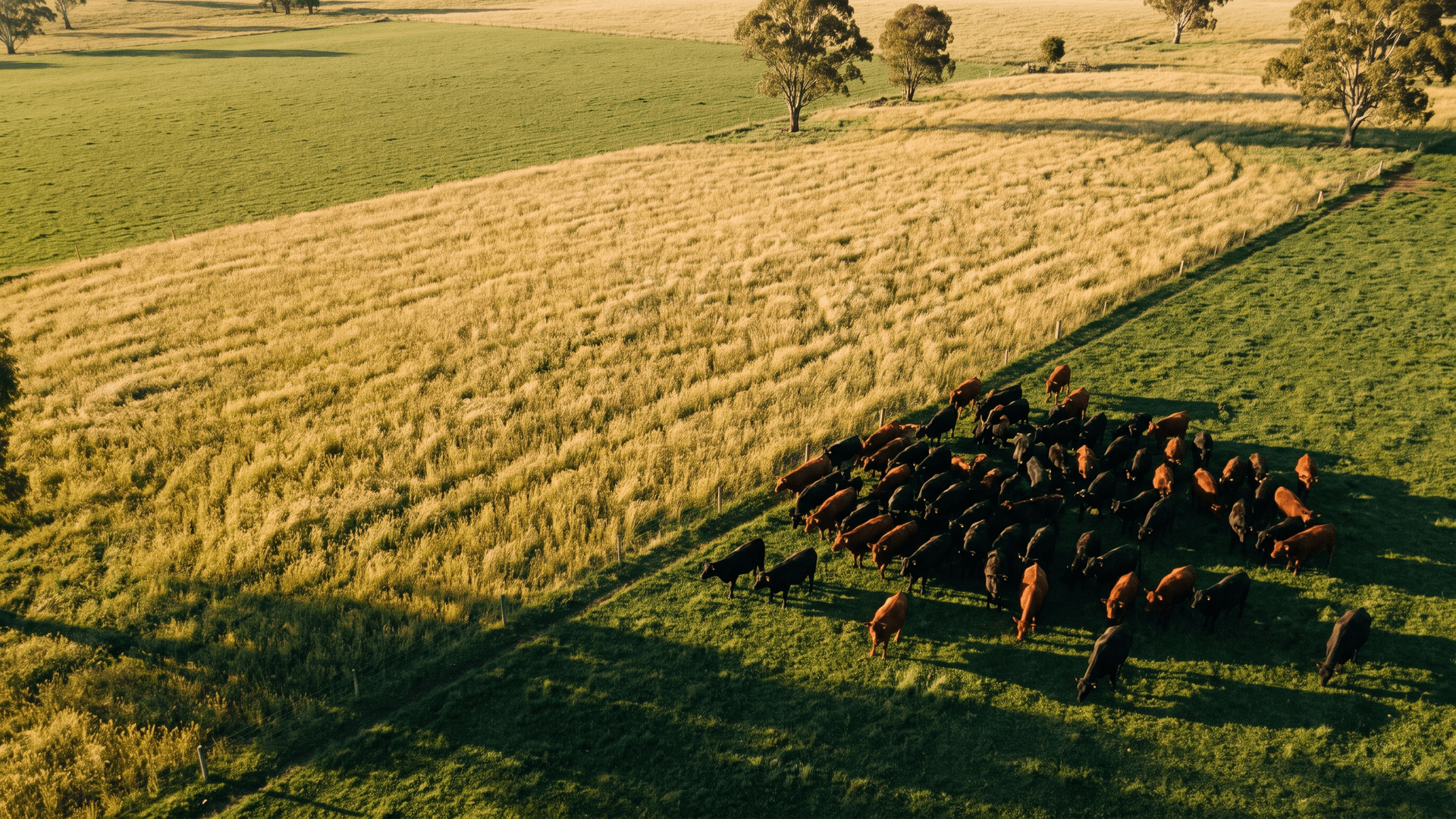
What Is Regenerative Farming, and Does It Actually Work?
By Rob Moffatt & Damien Moffatt, Co-founders, ButcherCrowd
Short answer: Regenerative farming is an approach rather than a certification. Conventional farming asks how much output a paddock can produce; regenerative farming asks how the land can be improved while it produces. In practice that usually means rotational grazing with planned recovery periods. In Australia the strongest evidence is for ground cover: a ten-year Burdekin catchment study found sediment loss dropped sharply once cover passed 70%, and a 130-farm national study found ground cover and forage condition were the two natural capital measures most closely associated with farm profitability. Soil carbon gains are far less certain, and CSIRO rates the evidence for rotational grazing specifically as low confidence.
The UN's Food and Agriculture Organization warned in 2022 that 90% of the Earth's topsoil is likely to be at risk by 2050, and that the equivalent of a football field of soil erodes every five seconds [1]. That is a global figure, and global figures are easy to nod along to without feeling much.
The Australian version is more useful. About 530 million tonnes of soil organic carbon, or 12.6% of the original amount, has been lost from the top 30cm of New South Wales soil since European colonisation, and NSW lost a further 3.1% between 2006 and 2020 alone [2]. This is not a future problem. It has been running for two centuries and it is still running.
It Is a Question, Not a Certification
There is no legal definition of regenerative farming in Australia, and no certification body that owns the term. That cuts both ways: genuinely good farms can practise it without paperwork, and anyone at all can put the word on a label.
The most useful way to think about it is as a different question being asked of the same paddock.
Conventional farming asks how much output this land can produce. Inputs are added to hit that number, and soil is treated as the medium the pasture grows in. Regenerative farming asks how the land can be left better than it started while still producing food. Soil is treated as a living system with its own biology to be fed.
Both are farming. The difference is what counts as success at the end of a season.
What Actually Changes on the Ground
For a grazing operation, the practical change is how animals move.
Under continuous grazing, stock have access to a large area for a long period. They graze selectively, returning to the plants they prefer before those plants have recovered, which slowly thins the pasture and exposes bare soil.
Under rotational or adaptive multi-paddock grazing, the herd is concentrated into a smaller area for a short period and then moved on, and that paddock is left alone to recover. The animals eat less selectively, their manure and urine spread more evenly, and hoof action presses litter into the surface. Then nothing touches it for weeks or months.
That is the whole mechanism. Short impact, long rest. Everything else follows from getting the rest period right, which is why the approach is called adaptive: recovery in a wet spring is not recovery in a dry summer.
Ground Cover Is the Number That Matters Here
Australian land management has a more concrete metric than carbon, and it is the one to watch: how much of the soil surface is actually covered by living plants and litter.
The best evidence we have is a ten-year study on a grazing property in the Burdekin catchment in north Queensland, where researchers reduced stocking rates and rested paddocks through the wet season and measured what happened from 2002 to 2011. Hillslope ground cover rose from around 35% to around 80%. Sediment concentrations in runoff dropped substantially, and the researchers identified a threshold: once ground cover held above 70%, sediment loss was minimised [3].
That 70% figure is worth remembering, because it is the number Australian graziers and catchment authorities actually manage to.
The same study is also honest about what did not happen, which is why it is worth citing rather than a press release. Total sediment leaving the catchment still rose in wet years, because gullies, scalds and stream banks kept eroding regardless of how good the pasture on the slopes looked. Native perennial grasses recovered only from 7% to 15% of the pasture composition in a decade. The authors concluded that restoring degraded rangeland takes considerably longer than ten years.
So: better grazing management demonstrably improves the soil surface, and the soil surface demonstrably controls erosion. It does not undo a century of damage in a few seasons.
Where the Evidence Gets Thin
Soil carbon is the claim you will see most often on a label, and it is the one Australian science supports least.
CSIRO's review of soil carbon sequestration potential for Australian agriculture, prepared for the federal government, scores each practice for both its likely effect and how confident we can be about it. Rotational grazing gets a small positive effect and a low confidence rating, with the plain-language note that the mechanism is plausible, through increased productivity and root turnover, but "lacking field evidence" [4]. Shifting to perennial species, by contrast, scores a larger effect at medium confidence, and restoring genuinely degraded land scores highest of all.
Australian field work has borne that out. Research on native grass-based pastures in southern Australia found no difference in soil carbon stocks between rotationally and continuously grazed properties [5].
The international picture is split rather than settled. A 2025 review of rotational grazing in beef systems found only about 46% of studies reported a positive effect on soil organic carbon, with the remaining 54% neutral or none [6]. The strongest positive result comes from the United States, where a study pairing adaptive multi-paddock ranches against neighbouring conventional ones in the southeast found soil carbon stocks to one metre over 13% greater, standing biomass more than 300% higher, and better water infiltration, while carrying more livestock [7]. That is a real finding, but it is Georgia and Mississippi rainfall on American soils, and it should not be quietly imported as an Australian result.
The fair summary: move animals well and you reliably improve ground cover, pasture and how soil handles water. Whether you also bank carbon depends on soil type, rainfall, starting condition and how long you have been at it, and in Australia the honest answer is that we do not yet know.
Anyone selling you regenerative meat on a carbon claim is ahead of the evidence. Anyone selling it on ground cover and soil function is not.
The Australian Finding That Matters Most
The most interesting recent Australian research does not measure carbon at all. It measures money.
Farming for the Future, a program run through the Macdoch Foundation with Meat & Livestock Australia, collected detailed ecological and financial data from 130 livestock businesses across NSW, Victoria, Tasmania and southern Western Australia. It is the largest dataset of its kind anywhere.
The headline result is that the condition of a farm's natural capital was positively correlated with its financial performance. Farms at optimised natural capital levels ran median earnings before interest and tax $75 to $175 per hectare per year higher in the Central and Tablelands region, $20 to $135 higher in the south-east, and around $70 higher in the west. High natural capital farms also carried lower input costs for energy, fodder, animal health and labour, and showed more resilience to both drought and market shocks. The proposed mechanism for the drought resilience is water retention in farm soils [8].
Two of the specific measures significantly associated with profitability were ground cover and forage condition: the same things the Burdekin study showed control erosion.
This is an association across many farms, not proof that any one practice causes profit, and the program measured natural capital broadly rather than "regenerative farming" as such. But the direction is clear enough, and it reframes the whole subject. Looking after the paddock is not a cost that a farm absorbs for the sake of the environment. On this evidence it is part of how the better farms make money.
Why Any of This Reaches Your Plate
The chain is real, but worth stating precisely rather than romantically.
Better ground cover means soil that takes in rain instead of shedding it, which means more pasture, of more species, for more of the year. That is what allows animals to be finished on grass rather than shifted onto grain when the paddock runs short. An animal that stays on pasture its whole life produces meat with a different fat profile to one finished in a feedlot, which is well established and is the reason grass-finished beef tastes and cooks the way it does.
What we will not claim is that regeneratively grazed meat is measurably more nutritious than other grass-finished meat. We have not seen evidence for it, and the honest position is that this practice is about the land and the durability of the farm rather than a nutrition label.
The clearest benefit to you is less romantic and more useful. Farms that hold water and grow pasture through a dry stretch are farms that are still here in ten years, still supplying, and still able to farm the way you would want them to.
Where ButcherCrowd Fits
We do not certify our farms as regenerative, because no meaningful Australian certification exists to hold them to. What we can tell you is how they operate.
Grass-fed and grass-finished beef and lamb. Open pasture, year-round, rotationally grazed, and never finished in a feedlot. Grass-finishing is not a marketing preference for us. It is the condition that makes the grazing management possible in the first place.
The NEVER EVER Program. No antibiotics, no added hormones for growth promotion, and Certified Humane.
Farmers set their own price. We do not push producers down on price. A farm squeezed on margin cannot afford long recovery periods or the patience this management needs, and the Farming for the Future data suggests the causation runs both ways. Financially viable farms are a precondition for well-managed land, not a separate issue from it.
Direct relationships, no middlemen. We buy whole animals from producers we know by name, which is the only reason we can tell you any of the above with confidence.
Grass-fed, grass-finished, and never in a feedlot
Every cut of ButcherCrowd beef and lamb comes from open pasture, year-round, from Australian farms we know by name. No antibiotics, no added hormones for growth promotion, Certified Humane.
Build your box →Frequently Asked Questions
Is regenerative farming the same as organic?
No. Organic is a certified standard that restricts which inputs a farm may use. Regenerative describes an approach to improving the land, has no single certification in Australia, and says nothing directly about inputs. A farm can be one, both, or neither.
Does regenerative grazing store carbon in Australian soil?
Less reliably than is often claimed. CSIRO's review for the federal government rates the soil carbon effect of rotational grazing as small and low confidence, noting the field evidence is lacking, and Australian research on southern native pastures found no difference between rotational and continuous grazing. The ground cover and soil function benefits are much better supported than the carbon benefits.
What ground cover should a grazing property aim for?
The Burdekin research identified 70% as the point above which sediment loss from hillslopes was minimised, and it is a widely used benchmark in Australian grazing management. Below that, bare soil starts moving whenever it rains hard.
Is regenerative farming actually profitable?
The Farming for the Future study of 130 Australian livestock businesses found farms with better natural capital had median EBIT $20 to $175 per hectare per year higher depending on region, alongside lower input costs and better resilience to drought and market shocks. That is an association rather than proof of cause, but it is the largest dataset of its kind and it points one way.
Is "regenerative" on a label meaningful?
On its own, no, because nobody owns the term. Ask what the farm actually does: how long the recovery periods are, whether animals are finished on pasture, and whether the seller can name the producer.
The information in this article is for general educational purposes only and does not constitute medical or nutritional advice. If you have specific health concerns or dietary requirements, consult a qualified healthcare professional.
References
- FAO warns 90 per cent of Earth's topsoil at risk by 2050 (July 2022), UN News: news.un.org
- Soil condition 2024, NSW State of the Environment, NSW EPA: soe.epa.nsw.gov.au
- Bartley R et al. (2014), Can changes to pasture management reduce runoff and sediment loss to the Great Barrier Reef? The results of a 10-year study in the Burdekin catchment, Australia, The Rangeland Journal 36(1): 67-84: doi.org
- Sanderman J, Farquharson R & Baldock J (2010), Soil Carbon Sequestration Potential: A review for Australian agriculture, CSIRO Land and Water, for the Department of Climate Change and Energy Efficiency: mla.com.au
- Impacts of Rotational Grazing on Soil Carbon in Native Grass-Based Pastures in Southern Australia: ncbi.nlm.nih.gov
- A scoping review on the impact of rotational grazing in beef cattle systems on greenhouse gas emissions, soil health, plant diversity, and plant productivity parameters (2025), Canadian Journal of Animal Science: cdnsciencepub.com
- Vegetation, water infiltration, and soil carbon response to Adaptive Multi-Paddock and Conventional grazing in Southeastern USA ranches, Journal of Environmental Management: sciencedirect.com
- Farming for the Future, Project P.PSH.1389 final report, Macdoch Foundation and Meat & Livestock Australia (2024): farmingforthefuture.org.au
ButcherCrowd is better
BETTER FOR THE FARMING & FISHING FAMILIES, THE ANIMALS, THE ENVIRONMENT AND BETTER FOR YOU. A BETTER WAY OF EATING MEAT.
SKIP, PAUSE OR CANCEL ANYTIME


