
Fresh vs Frozen Meat: What the Science Actually Says
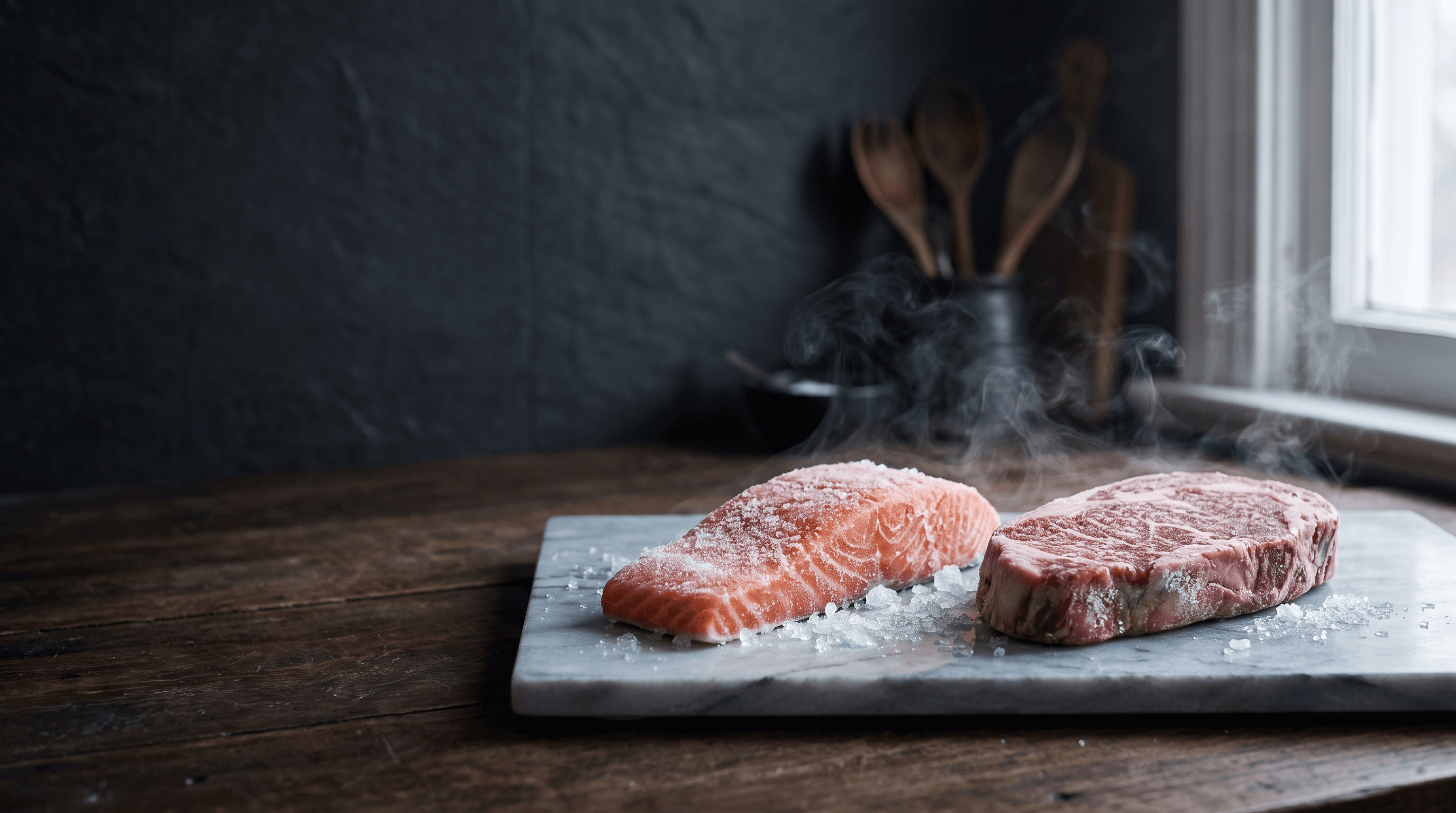
Fresh vs Frozen Meat: What the Science Actually Says
By Rob Moffatt & Damien Moffatt, Co-founders, ButcherCrowd
Short answer: Meat rapid-frozen soon after processing is often fresher than supermarket "fresh" meat that has aged for weeks in the supply chain. Australia's Better Health Channel confirms freezing retains a food's nutrients, and food scientists find quality depends on how fast meat is frozen, not whether it is frozen.
Most of us grew up with a simple rule: fresh is better than frozen. It feels obviously true. The steak sitting pink and bright in the supermarket case looks fresher than anything in a freezer bag.
But "fresh" at a supermarket doesn't mean what most people think it means. Once you look at how chilled meat actually gets to that shelf, and what the science says freezing does and doesn't do, the comparison flips.
How Old Is "Fresh" Supermarket Meat, Really?
That bright red steak in the chilled case was not cut this morning.
Most supermarket meat in Australia is packed centrally and trucked out in modified atmosphere packaging (MAP): sealed trays flushed with a gas mix that slows spoilage and keeps meat looking red. In Australian retail it stretches the chilled display window out to roughly 8 to 10 days [1], and some MAP systems push it further still [2]. Before that, beef is commonly stored in vacuum packs, where CSIRO puts the storage life of chilled beef at three to four months near freezing [3].
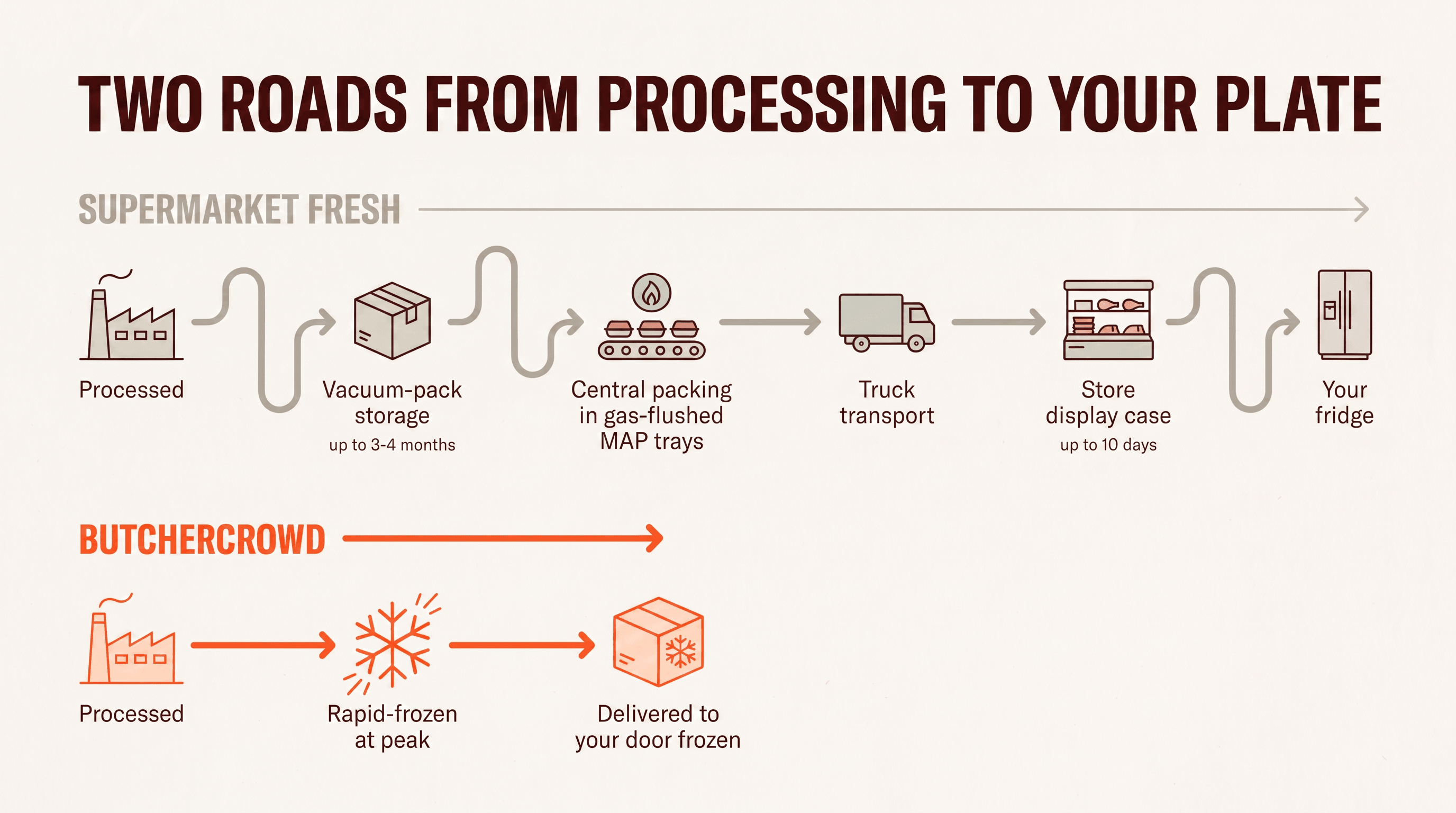
None of this is unsafe, but it means "fresh" on a shelf means "not frozen," not "recent." A Meat Standards Australia trial found MAP-packed beef lost significant tenderness by day nine, a drop of 12 points on the MSA tenderness scale [4].
What Freezing Actually Does to Meat
Here's the part the freezer aisle never got credit for: freezing essentially presses pause.
Australia's Better Health Channel states plainly that the nutrient value of a food is retained when it is frozen [5]. A 2025 research review found the meaningful quality changes come from how meat is frozen and how long it's stored, not from freezing itself [6]. Meanwhile chilled meat keeps degrading from the day it's processed [7]. Meat frozen shortly after processing locks in its state at that moment.
How It's Frozen Matters More Than Whether It's Frozen
The real difference between good and bad frozen meat is speed.
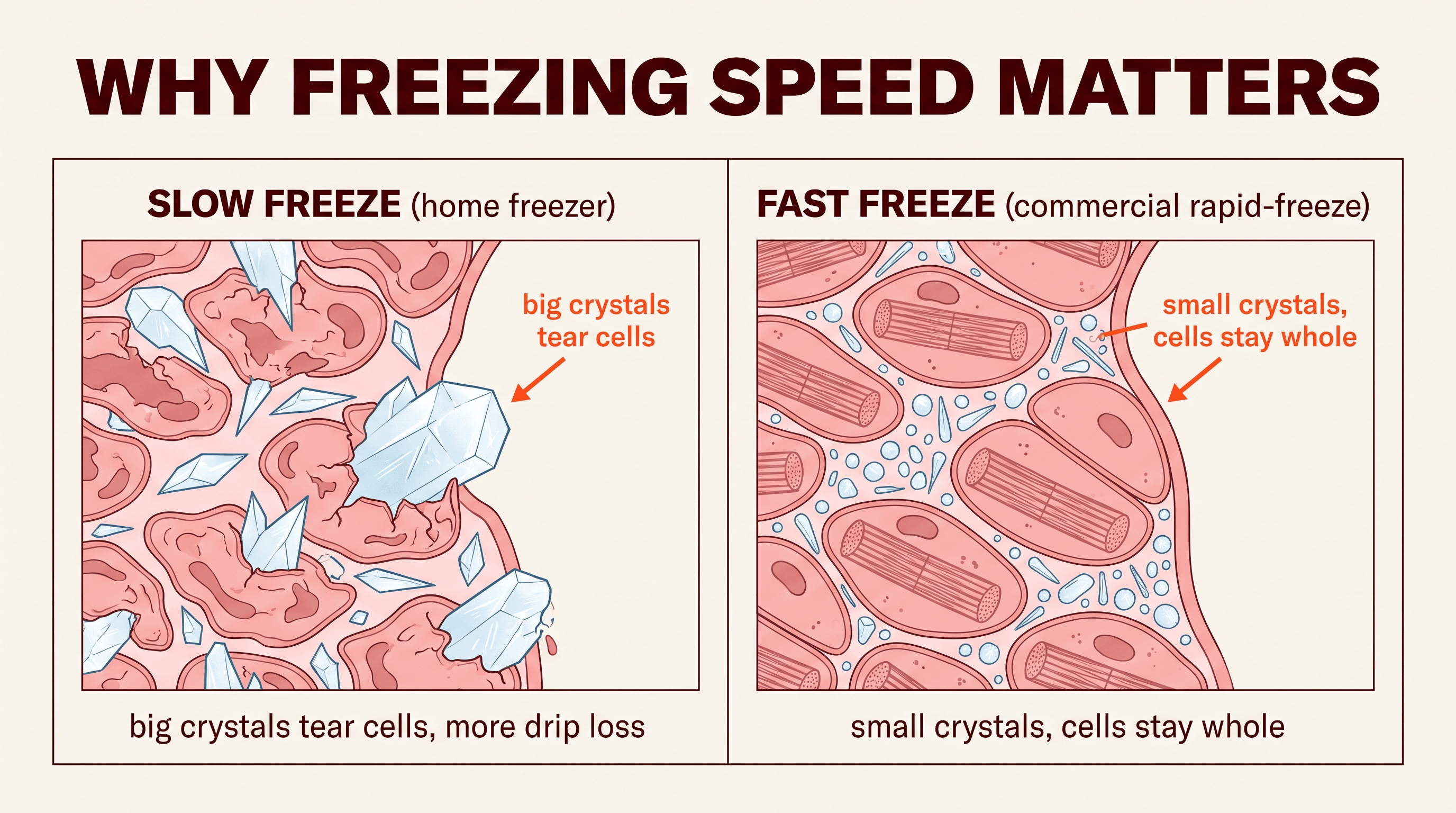
Freeze meat slowly and large ice crystals puncture cell walls, so more moisture escapes as drip loss when it thaws [6]. Freeze it fast and the crystals stay small, the structure stays intact, and thawed meat comes out close to the day it was frozen [6]. The same logic applies to seafood — freezing speed is what separates good frozen fish from bad.
The Honest Trade-Offs
Frozen isn't magic. You need to plan ahead: thaw in the fridge, not on the bench. Freezer burn is real if packaging is compromised. And as CSIRO points out, raw meat thawed in the fridge can be refrozen safely (you lose a little quality each time), but anything thawed on the bench should not go back in the freezer [8]. If you buy from a butcher who cut it that week and cook it within a couple of days, chilled fresh is excellent. The realistic comparison is rapid-frozen meat versus meat that has spent its shelf life in trucks and gas-flushed trays.
Watch a ButcherCrowd Unboxing
Here's a real unboxing. Everything lands frozen solid, exactly as it left processing:
Meat frozen at its peak, delivered to your door
100% grass-fed and finished beef, free-range chicken and pork, and wild-caught seafood. Rapid-frozen the way the science says it should be, never aged for weeks on a supermarket shelf.
Build your box →Frequently Asked Questions
Is frozen meat as good as fresh meat?
Yes. Australia's Better Health Channel states the nutrient value of a food is retained when it is frozen. Quality depends on how fast meat is frozen. Meat rapid-frozen soon after processing is often fresher than chilled meat that has spent weeks in the supply chain.
How old is fresh supermarket meat?
It can be weeks old. Supermarket meat is typically packed in gas-flushed modified atmosphere packaging that extends the chilled display window to 8 to 10 days, and before that it is often stored in vacuum packs for weeks.
Does freezing meat destroy nutrients or protein?
No. Freezing does not destroy protein or most nutrients. Some water-soluble B vitamins can be lost in the liquid that escapes during thawing, but researchers consider the amounts nutritionally trivial.
Why is rapid-frozen meat better than meat frozen at home?
Speed changes the ice. Slow home freezing forms large crystals that puncture cells, causing drip loss. Fast commercial freezing forms tiny crystals that leave the structure intact, so thawed meat is much closer to how it was before freezing.
What is the best way to thaw frozen meat?
Thaw meat slowly in the fridge, ideally overnight, rather than on the bench. Fridge thawing keeps it at a safe temperature and reduces moisture loss.
The information in this article is for general educational purposes only and does not constitute medical or nutritional advice. If you have specific health concerns or dietary requirements, consult a qualified healthcare professional.
References
- Modified atmosphere packaging and red meat retail display life, Meat & Livestock Australia: mla.com.au
- MAP shelf-life extension of meat products, Fitmeat: fitmeat.at
- Storage life of chilled vacuum-packed beef, CSIRO Meat Industry Services: meatupdate.csiro.au
- Meat Standards Australia MAP tenderness trial, reported by Beef Central: beefcentral.com
- Food processing and nutrition (freezing retains nutrient value), Better Health Channel, Victorian Government: betterhealth.vic.gov.au
- Effects of Freezing, Frozen Storage and Thawing on Meat: A Review (2025): ncbi.nlm.nih.gov
- Extending the shelf life of fresh food, CHOICE: choice.com.au
- You can thaw and refreeze meat: five food safety myths busted, CSIRO: csiro.au
ButcherCrowd is better
BETTER FOR THE FARMING & FISHING FAMILIES, THE ANIMALS, THE ENVIRONMENT AND BETTER FOR YOU. A BETTER WAY OF EATING MEAT.
SKIP, PAUSE OR CANCEL ANYTIME


