
Wagyu Beef Buyer's Guide: Grades, Marble Scores and Feeding
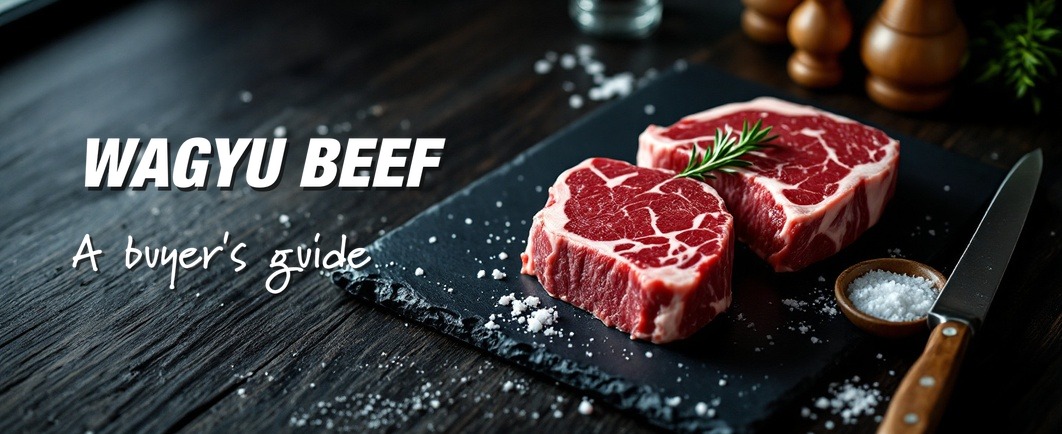
"Wagyu" on a menu or a pack can describe very different pieces of meat. It might be a crossbred steak that is half wagyu with moderate marbling. It might be a Fullblood cut from an animal that spent well over a year on a grain ration. Price can be a clue, but the label often won't tell you which.
Three things decide what you're buying: the animal's genetics, its marble score, and how it was finished. This guide explains each one, what the research says about why wagyu fat behaves differently, and how to cook a wagyu steak so you get what you paid for.
What is wagyu beef?
Wagyu refers to Japanese cattle breeds. In Japan there are four: Japanese Black, Brown, Shorthorn and Polled. Japanese Black makes up by far the largest share of the population, and it's the breed most wagyu research focuses on [1].
In Australia, the Australian Wagyu Breeders Association was formed in 1989. The Australian herd is built on the three major black wagyu strains (Tajima, Fujioshi and Kedaka) plus two red strains (Kochi and Kumamoto), and the Australian Wagyu Association describes it as the largest outside Japan [2].
What sets the breed apart is its genetic capacity to lay down intramuscular fat, the fine white flecks through the meat known as marbling. One study summarised in a 2016 review measured around 23% intramuscular fat in the wagyu loin muscle, against roughly 4% in German Angus [3]. Figures like these vary widely with diet, age and the muscle sampled, but the direction is consistent across the research.
Reading the label: Fullblood, Purebred and crossbred
The Australian Wagyu Association uses grades that describe how much wagyu is in the animal. These are the terms you'll see on packs and menus [4]:
| Label | What it means |
|---|---|
| Fullblood | Parent-verified to a registered Fullblood sire and dam |
| Purebred | 93.75% wagyu content or more, parent-verified to sire and dam |
| F3 crossbred | 87.5% to under 93.75% wagyu |
| F2 crossbred | 75% to under 87.5% wagyu |
| F1 crossbred | 50% to under 75% wagyu, typically a wagyu crossed with another breed |
Two things are worth knowing here.
"Wagyu" on its own doesn't tell you the content. An F1 steak is roughly half wagyu. It can be excellent beef, but it's a different product from a Fullblood steak, and it's reasonable to expect the price to reflect that.
These are genetic grades, not quality grades. A Fullblood label tells you about ancestry. It doesn't tell you how marbled a particular steak is, which is where the marble score comes in.
Marble scores: what MB5+, 9+ and A5 mean
In Australia, marbling is graded under the AUS-MEAT system. An AUS-MEAT qualified grader assesses the carcase visually and scores it on a scale of 0 to 9+ [5]. The higher the number, the more intramuscular fat. An "MB5+" label means a marble score of 5 or above.
For context, the Australian Wagyu Association reports that Australian Fullblood wagyu regularly scores above 7 and typically averages a marble score of 8 [2][5]. Grass-finished wagyu generally sits lower on the scale than long grain-fed wagyu (more on that below).
You'll also see A5 on imported Japanese wagyu. That's a different system. The Japanese grade combines two parts [6]:
- Yield grade (A, B or C): the proportion of saleable meat from the carcase. "A" is 72% or more.
- Quality grade (1 to 5): based mainly on marbling, plus meat colour, firmness, texture and fat quality. Grade 5 corresponds to Beef Marbling Standard (BMS) numbers 8 to 12.
So A5 means a top yield grade and a top quality grade. It doesn't mean BMS 12, and it doesn't translate neatly into an Australian marble score. Treat the two systems as separate.
Grain-fed vs grass-finished wagyu
Labels often leave this part out, yet finishing has a large effect on how marbled the meat is.
Much of the highly marbled wagyu sold in Australia comes from long grain-feeding programs. The Australian Wagyu Association reported that in 2021, around 22,000 F1 and Purebred wagyu were fed for a minimum of 360 days, and around 700 Fullblood wagyu for a minimum of 500 days [7]. Industry-wide, the average time wagyu spent on feed was about 155 days at the end of 2025, according to the ALFA and MLA feedlot survey, with roughly 227,000 wagyu on feed at that point [8].
Meat & Livestock Australia is direct about the effect: wagyu fed for 300 or more days on a grain-based diet "will be highly marbled and higher in fat compared to meat from grassfed Wagyu" [9].
Genetics still show up on pasture, though. A 2024 study of pasture-based cattle in Australia found wagyu had the highest intramuscular fat of the three breeds tested (a median of 11.1%, compared with 8.0% for Angus and 5.9% for Hereford) [10]. So grass-finished wagyu generally carries less marbling than long-fed grain wagyu, but it can still be more marbled than other pasture-raised beef.
Neither approach is "right". They're different products. Long grain-feeding produces the very high marble scores wagyu is famous for. Grass-finishing produces wagyu raised on pasture for its whole life, usually with more moderate marbling. If the label doesn't say how the animal was finished, ask. Our guide to what grass-finished actually means covers the terminology in more detail.
Why wagyu fat behaves differently
Wagyu fat is softer than the fat on most beef, and that comes down to its composition.
Wagyu tends to carry a higher proportion of monounsaturated fat, particularly oleic acid [3]. One comparison cited in a 2016 review found oleic acid made up about 53% of wagyu subcutaneous fat, against about 35% in hay-fed Angus [3]. An enzyme called stearoyl-CoA desaturase (SCD) converts saturated fatty acids into monounsaturated ones, and it was the first gene linked to fatty acid composition in beef [1].
More monounsaturated fat means a lower melting point. In the 2024 pasture-based study, wagyu fat melted at around 33°C, compared with 46.5°C for Angus and 55°C for Hereford [10]. Research on long-fed wagyu has found melting points generally below body temperature, with large differences between the progeny of individual sires [11]. That's the source of the "melts in your mouth" description: in many wagyu steaks, the fat can begin to soften at around body temperature.
These are differences in fat composition. They aren't health claims, and the research above doesn't make any.
How to cook a wagyu steak
Marbling gives you some margin for error, but less than people assume.
A Journal of Animal Science study found that more marbling helps make up for the loss of juiciness when steak is cooked to higher temperatures, but offers less protection for tenderness and flavour [12]. In plain terms: a well-marbled steak cooked well done will stay juicier than a lean one, but it can still lose tenderness and flavour.
A few practical guidelines:
- Cook hot and fast. A heavy pan or a hot grill, a short cook each side, and a few minutes' rest.
- Aim for medium-rare to medium. That gives the fat time to soften without drying out the meat.
- Use a thermometer if you have one, and allow a few degrees for carryover heat during resting.
- Keep seasoning simple. Salt is often enough. Marbling carries a lot of flavour on its own.
- Go smaller on portions as the score rises. Many people find very high marble scores rich, so thinner slices or shared steaks are common at the top end.
A quick wagyu buyer's checklist
Before you buy, look for (or ask about) these five things:
- Genetics: Fullblood, Purebred, or crossbred (F1, F2, F3)?
- Marble score: an AUS-MEAT score such as MB5+, or a Japanese grade such as A5?
- Finishing: grain-fed (and for how many days), or grass-finished?
- Cut: porterhouse, scotch fillet, rump and others all carry marbling differently.
- Origin: Australian or imported, and can the seller tell you where it was raised?
If a seller can answer all five, you know what you're paying for.
Wagyu FAQs
Is all wagyu grain-fed? No. Much of Australia's highly marbled wagyu is grain-fed for 300 days or more, but wagyu is also raised and finished entirely on pasture. Grass-finished wagyu generally has less marbling than long grain-fed wagyu [9].
What does MB5+ mean on wagyu? It means the beef was graded at marble score 5 or higher on the AUS-MEAT scale, which runs from 0 to 9+ [5].
Is A5 wagyu the same as marble score 9+? No. A5 is a Japanese grade combining a yield grade (A) with a quality grade (5). Quality grade 5 covers BMS 8 to 12 in the Japanese system, which is separate from the Australian AUS-MEAT scale [6].
Is wagyu steak cooked differently to other steak? The principles are the same, but there's less reason to go past medium. Marbling protects juiciness at higher temperatures better than it protects tenderness and flavour [12].
Wagyu at ButcherCrowd
We source all our beef the same way: 100% grass-fed & grass-finished, from Australian farming families. You can read more about how we source our meat. Our wagyu follows the same rule.
Our Wagyu Porterhouse is 100% grass-fed & grass-finished and graded MB5+. It's raised on pasture from start to finish rather than finished in a feedlot, which is a less common route for wagyu. It comes as two 200g steaks, vacuum-sealed and rapid-frozen, and is available as an add-on to any box.
As with every custom box we deliver, you're in full control of your subscription. Skip, pause or cancel anytime.
The information in this article is intended for general educational purposes only and does not constitute medical or nutritional advice. Individual dietary needs vary. Please consult a qualified health professional before making significant changes to your diet.
References
[1] The Japanese Wagyu beef industry: current situation and future prospects — a review. Gotoh, T., Nishimura, T., Kuchida, K. & Mannen, H. Asian-Australasian Journal of Animal Sciences. 2018. https://www.animbiosci.org/journal/view.php?doi=10.5713/ajas.18.0333
[2] World's Luxury Beef. Australian Wagyu Association. https://www.wagyu.org.au/worlds-luxury-beef
[3] Characteristics and Health Benefit of Highly Marbled Wagyu and Hanwoo Beef. Gotoh, T. & Joo, S.-T. Korean Journal for Food Science of Animal Resources. 2016. https://pmc.ncbi.nlm.nih.gov/articles/PMC5243954/
[4] Wagyu Content Check. Australian Wagyu Association. https://www.wagyu.org.au/help-article/wagyu-content-check
[5] Wagyu Beef Grade and Marbling Score. Australian Wagyu Association. https://www.wagyu.org.au/worlds-luxury-beef/wagyu-beef-grade-and-marbling-score
[6] About Meat: Beef Grading. Japan Meat Information Service Center. https://www.jmi.or.jp/en/info/index2.html
[7] Success and support of the Wagyu sector. Australian Wagyu Association. 2022. https://www.wagyu.org.au/wagyu-sector-success
[8] Wagyu on feed declines during 2025. Dalgleish, M. AuctionsPlus (citing ALFA/MLA feedlot survey data). 2026. https://pulse.auctionsplus.com.au/aplus-news/insights/wagyu-on-feed-declines-during-2025
[9] Grassfed and grainfed. Meat & Livestock Australia. https://www.mla.com.au/archived-sites/mla-healthy-meals/red-meat-nutrition/meat-nutrition/grassfed-and-grainfed/
[10] Muscle biopsy long-chain omega-3 polyunsaturated fatty acid compositions, IMF and FMP in Australian pasture-based Bowen Genetics Forest Pastoral Angus, Hereford, and Wagyu Beef Cattle. Otto, J. R. et al. BMC Veterinary Research. 2024. https://pmc.ncbi.nlm.nih.gov/articles/PMC10924329/
[11] Genetics of Marbling in Wagyu Revealed by the Melting Temperature of Intramuscular and Subcutaneous Lipids. Lloyd, S. S. et al. International Journal of Food Science. 2017. https://pmc.ncbi.nlm.nih.gov/articles/PMC5672612/
[12] Evaluation of marbling and enhancement's abilities to compensate for reduced beef palatability at elevated degrees of doneness. Drey, L. N. et al. Journal of Animal Science. 2019. https://pmc.ncbi.nlm.nih.gov/articles/PMC6358232/
ButcherCrowd is better
BETTER FOR THE FARMING & FISHING FAMILIES, THE ANIMALS, THE ENVIRONMENT AND BETTER FOR YOU. A BETTER WAY OF EATING MEAT.
SKIP, PAUSE OR CANCEL ANYTIME


