
Indoor vs. Outdoor Raised Meat Chickens in Australia: Welfare, Stress & Meat Quality
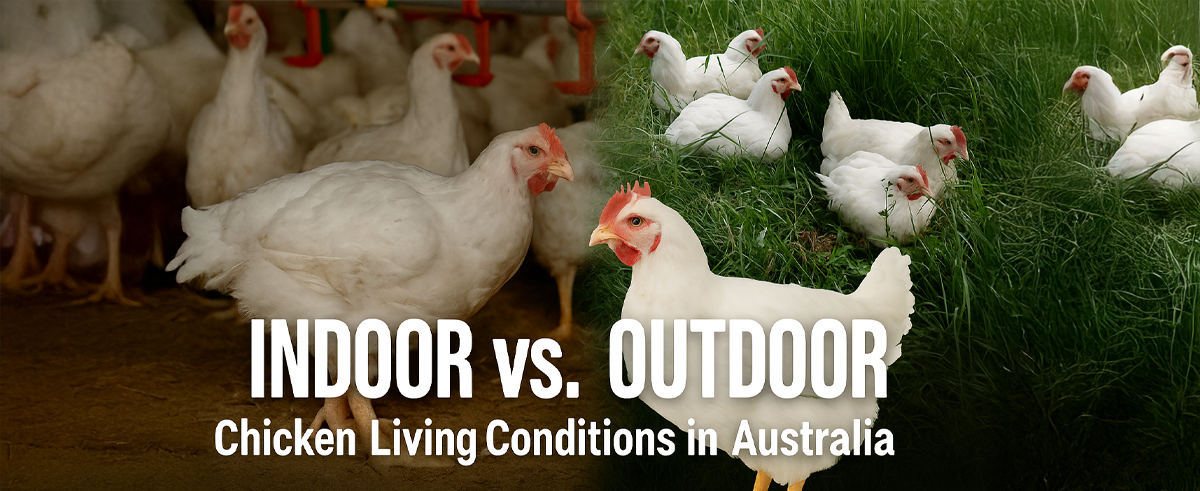
If you’ve ever wondered how your chicken was raised, you're not alone. The difference between indoor-raised and free-range & pasture-raised chicken in Australia is more than just where the birds live—it’s about their health, welfare, nutritional value, and ultimately, what ends up on your plate.
Industry Snapshot: Where Most Chicken Comes From
Each year, over 646 million broiler chickens are processed for meat in Australia. The overwhelming majority are raised in intensive indoor systems, with fewer than 25% coming from free-range or pasture-raised operations [1].
In intensive farms, up to 60,000 birds may be housed in a single shed. These environments are often windowless, with minimal room for movement, and little opportunity for birds to engage in natural behaviours [1][2].
Living Conditions and Animal Welfare
Indoor (Intensive) Systems
While broiler chickens in Australia aren’t caged, most live in large, densely packed sheds with limited access to fresh air, sunlight, or space to roam [1][2]. These fast-growing hybrid breeds are selected to reach slaughter weight within 5–7 weeks, which contributes to common welfare issues such as:
-
Lameness and skeletal deformities
-
Contact dermatitis from sitting in waste
-
Metabolic disorders and sudden mortality [3][4]
High stocking densities also prevent natural behaviours like dust bathing, foraging, and perching—resulting in chronic stress and reduced quality of life [1][2][4].
Outdoor (Free-Range & Pasture-Raised) Systems
In contrast, pasture-raised chickens in Australia have access to the outdoors, sunlight, and natural forage such as insects, grass, and seeds [5]. These systems often use slower-growing breeds, which grow at a more natural rate and avoid the health complications associated with intensive farming [4][5].
Pasture-raised systems promote:
-
Improved socialisation and behavioural expression
-
Better leg and foot health
-
Lower stress levels and improved immune response [4][5][6]
Stress and Health
Stress in indoor environments comes from overcrowding, poor air quality, and rapid growth pressure. This affects immune function and increases disease susceptibility. One Australian study found signs of bone infections in 28% of sampled birds, linked to rapid growth and environmental stress [4][6].
Chronic stress also affects meat quality—stress hormones impact muscle development and nutritional value [4].
Meat Quality and Nutrition
Indoor-Raised Chickens
The industry focus on yield has increased the occurrence of breast muscle myopathies (woody breast and white striping), which negatively affect texture, colour, and water retention of the meat [4].
These birds often have:
-
Higher fat content
-
Lower protein concentration
-
Muscle abnormalities that reduce eating quality [4]
Pasture-Raised Chickens
Pasture-raised chickens often produce meat with:
-
Higher protein and lower fat
-
Better fatty acid profiles, including more polyunsaturated fats and Vitamin E
-
A firmer texture and richer flavour—thanks to increased activity and natural diet [4][5]
Consumers consistently report a preference for the taste, appearance, and nutritional benefits of pasture-raised meat [4].
Summary Table: Indoor vs. Pasture-Raised Chickens
| Feature | Indoor-Raised | Pasture-Raised |
|---|---|---|
| Stocking Density | Very High (up to 60,000/shed) | Low – more space per bird |
| Access to Outdoors | None | Yes – daily access |
| Breed Type | Fast-growing hybrids | Slower-growing breeds |
| Welfare Concerns | High – lameness, dermatitis | Lower – better leg health |
| Social Behaviour | Limited | Encouraged – natural behaviours |
| Stress Levels | High | Low |
| Meat Quality | Higher fat, muscle defects | Leaner, higher protein, better taste |
Why It Matters
At ButcherCrowd, we believe better food starts with better farming practices. That’s why our chicken is always free-range and pasture-raised—never from feedlots or intensive sheds. We support producers who prioritise animal welfare, environmental sustainability, and clean, traceable nutrition.
By choosing pasture-raised chicken, you're investing in food that aligns with your values—whether that’s health, ethics, or quality.
👉 Build Your ButcherCrowd Box Today
Sources:
[1] Voiceless, 2020 – Voiceless Fact Sheet (PDF)
[2] RSPCA Australia – How Meat Chickens Are Farmed
[3] Alliance for Animals – Better Chicken Australia
[4] Compassion in World Farming – Meat Quality Issues (PDF)
[5] RSPCA Australia – Animal Welfare Challenges
[6] Frontiers in Animal Science – 2021 Study on Stress in Broilers
Disclaimer:
This article draws on publicly available research and resources from third-party organisations, including Voiceless, RSPCA Australia, and Compassion in World Farming. While ButcherCrowd aligns with many of the values presented, we encourage all readers to conduct their own research and form their own conclusions. We make no claims about specific producers outside of our own sourcing partners and cannot speak to the practices of all farms in Australia or globally.
ButcherCrowd is better
BETTER FOR THE FARMING & FISHING FAMILIES, THE ANIMALS, THE ENVIRONMENT AND BETTER FOR YOU. A BETTER WAY OF EATING MEAT.
SKIP, PAUSE OR CANCEL ANYTIME


